I Refused Every Snoring Fix for Twelve Years Until My Wife Went Behind My Back
I outlasted the strips, the straps, and the tennis ball my wife sewed into my shirt. The one thing I couldn't outlast came in a small box with my name on the label.
For twelve years I won every argument about my snoring by refusing to spend money on it.
Last month my wife spent $54.99 without asking me, and I lost the whole war in a single night.
This is a confession, not a review.
If you are the snorer in your house, the one who has said no to every fix, I wrote it for you, one stubborn man to another.
My name is Walt, I am 58, I inspect buildings for a county in Michigan, and I have snored since the second Clinton administration.
My wife Ruth has heard every night of it, from the far side of the bed and, in the later years, from the sewing room down the hall.
The Résumé of a Holdout
Ruth tried to fix me for years, and I outlasted every attempt.
I want to list them, because the list is the part I am least proud of.
Nasal strips: I wore them twice and announced they itched.
The chin strap: one night in the mirror looking like a man recovering from jaw surgery, and I had all the excuse I needed.
The wedge pillow migrated to a closet within a month.
She recorded me on a phone app once; I listened to nine seconds of it and handed the phone back without a word.
She sewed a tennis ball into the back of one of my undershirts, an old trick to keep a snorer off his back.
I unpicked the stitching at my workbench, and I am not proud of that either.
Every one of those failures had the same root cause, and it was not the products.
It was me. Admitting the problem was worth money meant admitting the problem was mine.
The Consult I Walked Out Of
Three years ago Ruth booked me a dental consult and drove me there herself.
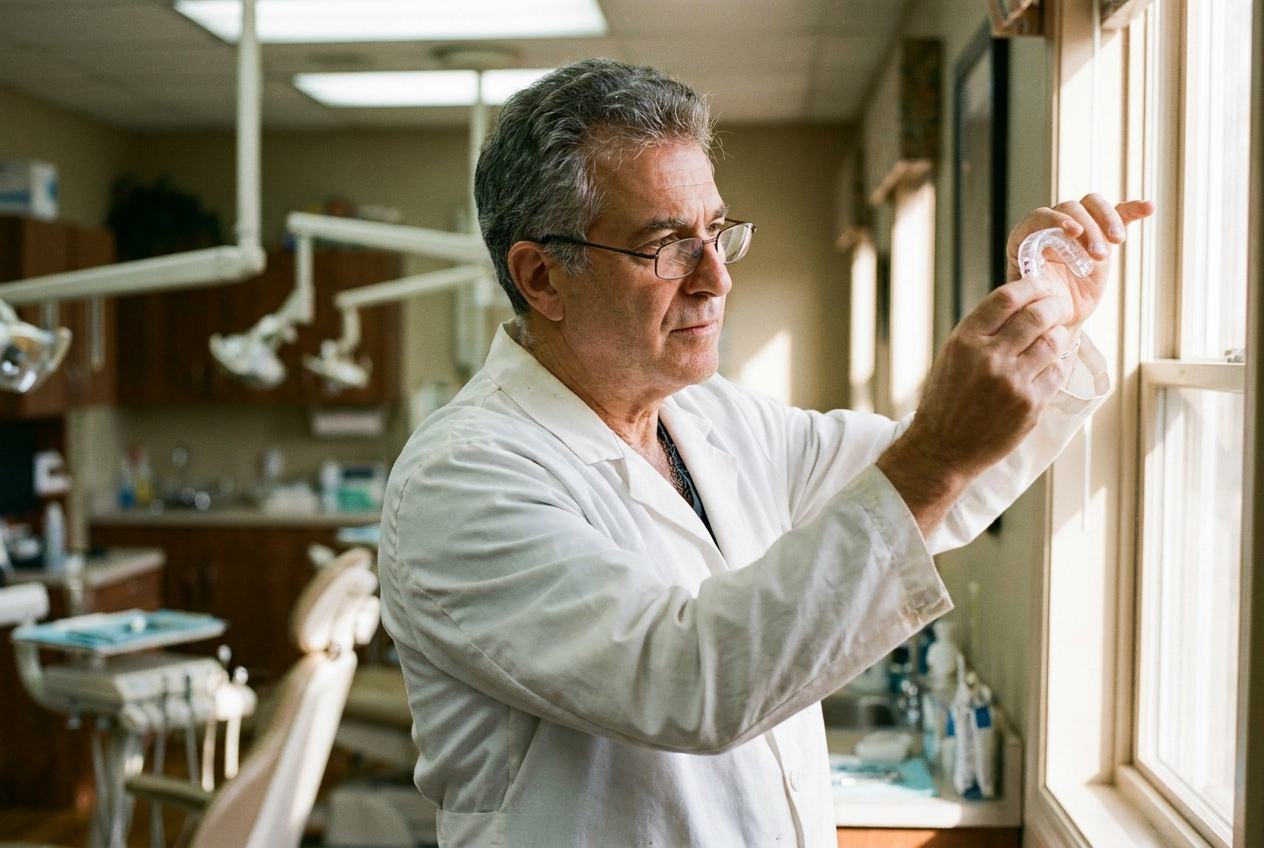
The dentist was decent and direct, and what he explained stayed with me longer than I let on.
During sleep the jaw muscles go slack and the lower jaw drifts backward.
The throat narrows behind it, and every breath has to push through the gap and set the tissue rattling. That rattle is the sound Ruth had been living beside for a decade.
He held up the fix his office makes: a custom mouthpiece that keeps the lower jaw seated forward through the night.
Lab-milled from impressions of my teeth, fitted and adjusted across half a dozen visits. The quote was $1,800.
I said I would think it over, in the tone every dentist recognizes as no.
For the next three years, that number did my arguing for me: any time the snoring came up, I had $1,800 to hide behind.
Here is what I know now and resent knowing.
The mechanism that dentist described was correct the whole time. The four-figure gate in front of it is what let a man like me call denial good sense for twelve years.
And while I stood behind that gate congratulating myself on the savings, the bill ran anyway.
Heavy snoring can hit roughly 80 decibels, motorcycle loud, and 31 percent of American adults now sleep apart from their partners. Ruth and I had quietly joined them, and neither of us said the word for what that was.
The Package With My Name on It
Last month a small box arrived addressed to me, and I had not ordered anything.
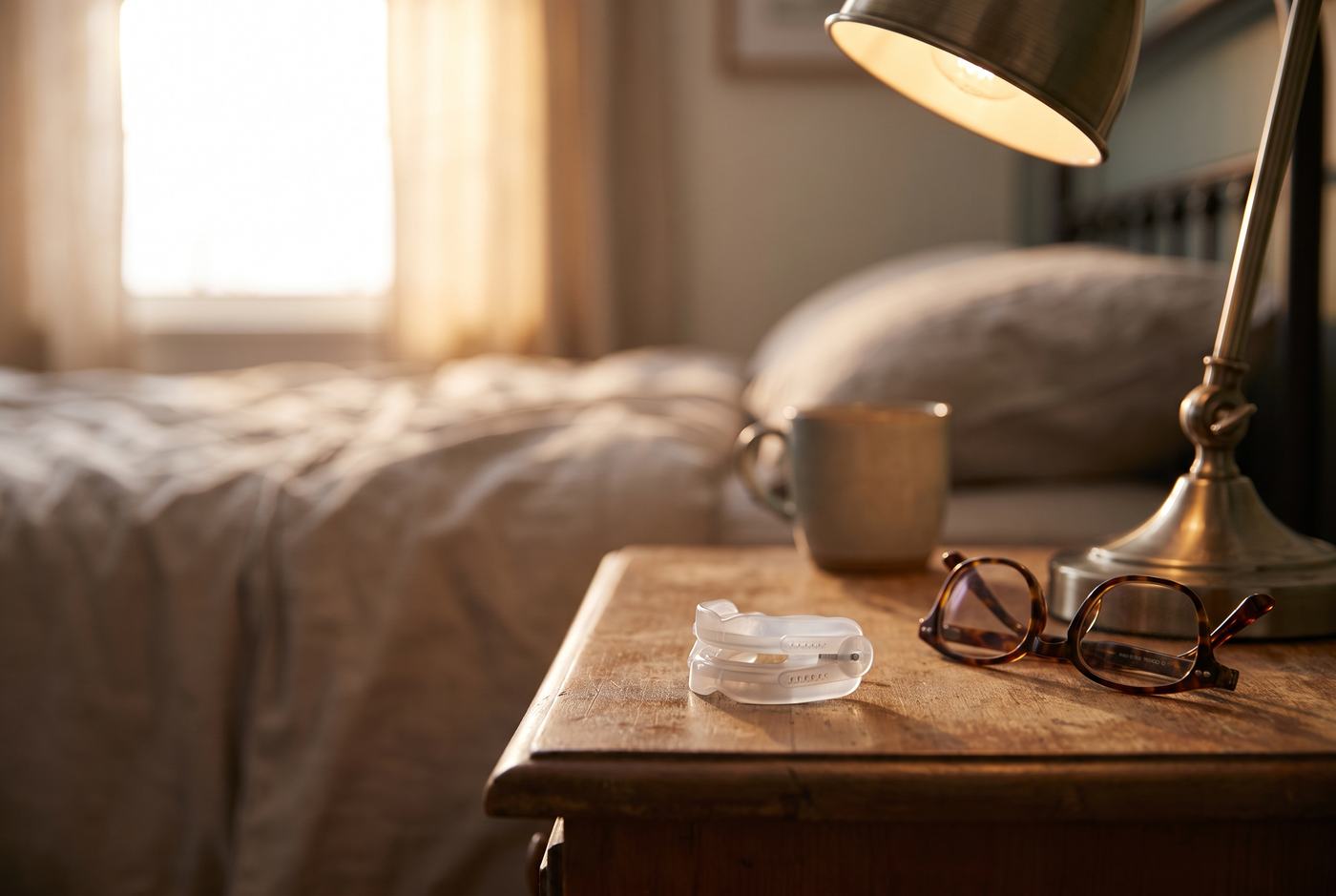
Inside was a mouthpiece called SnoreRX, and Ruth was standing in the kitchen doorway when I opened it.
She said one sentence.
"It cost fifty-five dollars. If you won't wear it, tell me the new reason, because the old one is gone."
I read the box looking for the catch.
Mandibular advancement: the same two words from that consult three years back. Molds to your own teeth at home. Adjustable in one-millimeter steps. FDA cleared, drug-free, made in the USA.
The price on the packing slip was $54.99.
My $1,800 shield had a $55 hole in it, and we both knew it.
The Part the Dentist Got Right
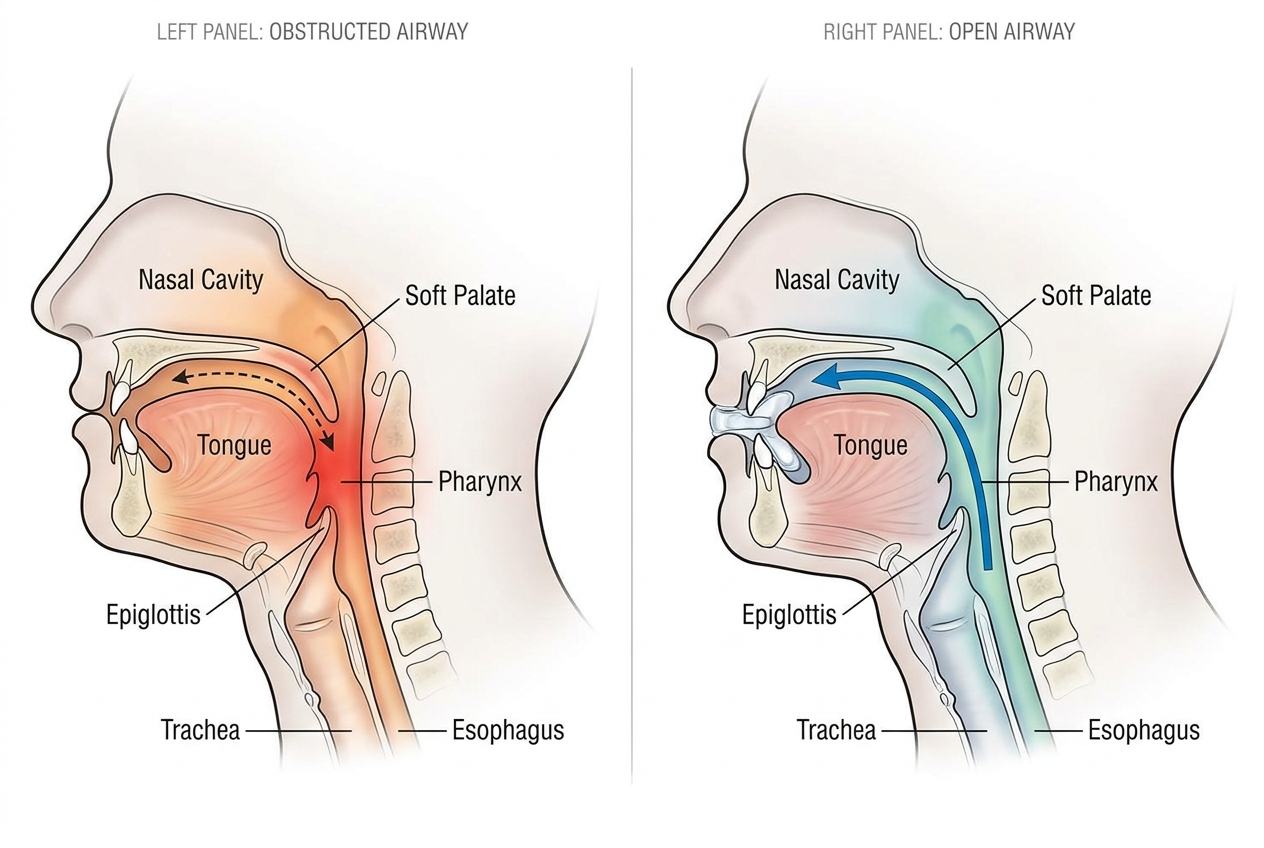
Both devices, the lab-milled one and the $55 one, work the same jaw-forward principle.
The custom version gets its shape from dental impressions; this one gets it from a pot of hot water on your own stove.
The fitting took one pot of water on the stove and one botched first try.
Heat the mouthpiece, bite into it, let it cool, and the material keeps the impression of your teeth. Mine came out crooked the first time; the instructions let you remold it, so no harm done.
The adjuster is the feature that made a skeptic pay attention.
You advance the jaw setting in one-millimeter steps until the noise settles, which is the same dialing-in the dentist's six office visits are for. I started at the lowest setting and moved it twice over the first week.
One boundary I will state plainly, because the instructions state it too.
This is a device for snoring. If a man gasps or stops breathing in his sleep, that is a question for a physician, not for anything sold in a box.
Losing the Argument
I wore it the first night to end the discussion, not because I believed in it.
I woke up at 2 a.m. out of pure habit, and the house was silent.
In the morning my head was clear in a way I had stopped expecting from a night in a bed.
Ruth asked what I had done differently, in the careful voice of a woman checking whether she is allowed to hope.
I will give you the honest drawbacks, because I went looking for them.
You will not look dignified wearing it; Ruth laughed at me the first night and was asleep before I could think of a comeback. It took most of a week before I stopped noticing it at all.
Reviewers who came over from the custom mouthpieces mention the trade-off I never had to make.
One former custom-mouthpiece patient wrote that "the fit will be a little loose if you are used to a custom fit job." I never had the custom job, so I had nothing to miss.
By the second week Ruth had moved her reading lamp back to our bedroom, and neither of us made a speech about it.
Week three, we drove overnight to her sister's, and I packed the mouthpiece before I packed my razor.
You can look over the mouthpiece and its current package pricing on the manufacturer's page here.
What I Paid, and What Twelve Years of Free Cost Me
The thing Ruth ordered is called the SnoreRX, an adjustable boil-and-bite mandibular advancement mouthpiece. It is FDA cleared, drug-free, and made in the USA, which is more than I ever bothered to check before I said no to it.
It carries a 30-Night Money-Back Guarantee. That is a full month of nights to test it, refunded if your house is not quieter, which is the deal I wish I'd taken twelve years ago.
Here is what I paid, off the maker's own site. One device ran me $54.99. If I'd bought two (Buy 1 Get 1 50% Off) it would have been $89.99, about $45 each, and three (Buy 2 Get 1 FREE) runs $119.98, which brings each one down to $40.
I ordered from the manufacturer's own site, and every link on this page goes to the same place, where the packages and the guarantee are listed.
The only deadline I will give you is the one I gave myself too late. Twelve years of free was the most expensive thing I ever bought.
Package options and availability are posted on the maker's page here.
Ruth has never once said I told you so.
She does not have to. Breakfast is quiet now, and not only because the snoring stopped.
If you are the holdout in your house, here is the sentence nobody could get through my head, so take it from a man who spent twelve years proving nothing.
Fifty-five dollars is the cheapest an argument like this will ever be to lose.
This page contains editorial content and paid promotion for SnoreRX. Individual results may vary. Names and stories are illustrative of common customer experiences. Walt is an illustrative narrator persona based on published customer accounts, not an identified customer. SnoreRX does not treat sleep apnea or any other medical condition. Anyone who has, or suspects they have, a sleep disorder should see a licensed physician before relying on an oral device.
This product is not intended to diagnose, treat, cure or prevent any disease. The information provided on this site is for informational purposes only and is not intended as a substitute for advice from your physician or other health care professional.
More Stories
The Snoring Fix Dentists Charge Two Grand For Cost Me $54.99 at My Own Kitchen Sink

I Spent 4 Years and $418.22 Grading My Own Snoring Cures Before My Husband Pointed Out I Had Never Once Heard Myself Snore
Your Skincare Routine Has a Blind Spot. Dermatologists Confirm It.